
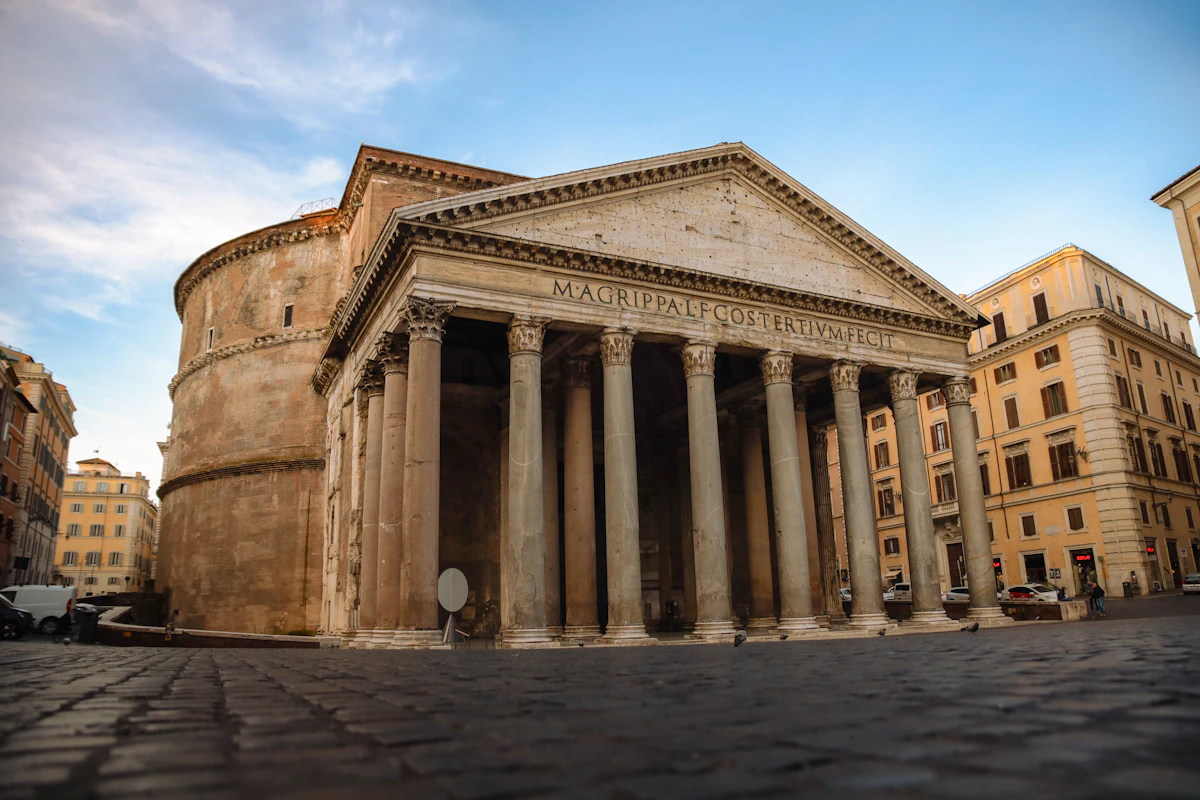
Pantheon Guide: Current Prices, Hours & Free-Sunday Rule
45 min - 1 h
Ancient Temple & Active Church
Rebuilt by Emperor Hadrian, completed c. 125 AD
Piazza della Rotonda, 00186 Roma, Italy
Planning to visit Pantheon of Rome?
Compare ticket and city-pass options for this attraction.
Practical Visitor Info & Tips
€7.00
€2.00
09:00 - 19:00, every day of the week
Reservation is optional, not mandatory — walk-up purchase at on-site kiosks remains available alongside online booking via museiitaliani.it. Security check required.
| Year-round, every day | Pantheon | 09:00 - 19:00 | Last Admission: 18:30 |
Closed On: 25 December and 1 January only. Open every other day of the year, including Sundays.
Free Admission Dates: Free on the first Sunday of each month — walk-in only, no online booking, free paper tickets issued on-site. (Some secondary sources report this applies every month year-round rather than only the traditional Oct-Mar window; that specific extension is not independently confirmed against a primary source.)
The Pantheon interior, including the tomb of Raphael. The Pantheon is an active church (Basilica di Santa Maria ad Martyres) and can close to tourism during religious services.
| Option | Price | Reservation | Booking |
|---|---|---|---|
| Adult | €7.00 | Optional | On-site or museiitaliani.it |
| Reduced (EU 18-25) | €2.00 | Optional | On-site or museiitaliani.it |
| Under 18 | Free | Optional | On-site or museiitaliani.it |
| First Sunday of the month | Free | Walk-in only, no booking | On-site ticket booths |
Overview & Visitor Introduction
The Pantheon is the best-preserved building from ancient Rome, famous for its unreinforced concrete dome and the 9-meter oculus at its center — still the world's largest unreinforced concrete dome nearly 1,900 years after it was built.
Standard admission is EUR 7.00 (EUR 2.00 reduced for EU citizens 18-25, free under 18), confirmed as current on the Ministero della Cultura's own page. Unlike the Colosseum, reservation here is genuinely optional, not mandatory — walk-up purchase at on-site kiosks remains available alongside online booking.
Because reservation is optional, most visitors simply arrive and buy at the door. The Ministero della Cultura's own visitor information describes entry as happening in the order people arrive, with no fast-track or 'skip the line' lane for anyone, ticket holders included — booking a time slot online mainly removes the small risk of finding a slot full, since each slot is capped at 1,200 people, rather than buying priority position once you're there. What genuinely does vary through the day is the oculus: it's a true 9-meter opening with no glass over it, so the shaft of daylight visibly moves across the coffered dome and marble floor as the sun shifts, and on the rare rainy day, water falls straight through onto the sloped, drained floor beneath it.
The building is also a working Catholic church, the Basilica di Santa Maria ad Martyres, and Mass is held on-site — Saturdays and the eve of holidays at 17:00, Sundays and holidays at 10:30, per the site's own visitor page. Ticket sales stop roughly an hour before each service, and only worshippers are admitted while Mass is underway, so a visit planned around a Sunday morning can run into a closed window despite the building technically being open that day. The same page asks visitors to dress appropriately for a place of worship — shoulders and knees covered — the standard applied at Rome's other churches and basilicas.
The entrance sits on Piazza della Rotonda in the historic center, a few minutes' walk from Piazza Navona and roughly a 10-minute walk from the Trevi Fountain, so it fits naturally into a walking route through that part of Rome rather than needing its own dedicated trip. It's also often a shorter visit than travelers expect: it's a single circular room, not a multi-room museum with a fixed circuit to work through, so many visitors are done well before the upper end of the duration estimate above — worth factoring in when planning a day that also includes a larger site like the Colosseum or the Vatican Museums.
History & Architectural Significance
The Pantheon was originally built by Marcus Agrippa under Emperor Augustus, then completely rebuilt by Emperor Hadrian around 125 AD after the original burned down. Its dome remains an engineering achievement: a coffered concrete structure that gradually thins and lightens toward the oculus, the open circular opening that is the building's only source of natural light.
In 609 AD, Byzantine Emperor Phocas gave the building to Pope Boniface IV, who consecrated it as the Basilica di Santa Maria ad Martyres — the conversion to a church is widely credited with saving it from the abandonment and stone-quarrying that destroyed many other ancient Roman monuments.
What to See: Top Highlights
The Oculus
The 9-meter circular opening at the dome's apex — the building's only light source, and open to the sky (rain does fall through on wet days).
Tomb of Raphael
The Renaissance master is buried here, along with several Italian kings.
The Portico
16 massive granite columns, each a single piece of stone transported from Egypt.
Which is the Best City Pass for Rome?
We analyze prices, ticket options, and transport deals for Rome.
Location & Google Maps
Pass Compatibility
Compare Rome PassesNot part of the Roma Pass or Omnia Card networks. Turbopass Rome City Pass includes it, with the reservation processed at checkout.
Roma Pass
Not included. Not part of the Roma Pass circuit.
Turbopass Rome City Pass
Included. The pass provider pre-books your entry ticket at checkout. Included in standard package.
Omnia Card 72h
Not included. Not part of the Omnia Card or the included Roma Pass circuit.
Data Provenance
Frequently Asked Questions
How much does the Pantheon cost?
Do I need to book in advance?
Is the Pantheon free on the first Sunday of the month?
Is the Pantheon included in Roma Pass or Omnia Card?
Is the Pantheon closed on any particular day?
How long should I plan for a visit?
Is the Pantheon still an active church?
Is the Pantheon accessible for wheelchair users?
Can I visit with young children?
What's the biggest mistake people make when visiting?
Will I still have to wait in line if I book a ticket online?
What should I wear to visit?
Is a City Pass Worth It in Rome?
Compare pass options, prices, ticket entry rules, and transportation.
View Rome Pass Comparison