
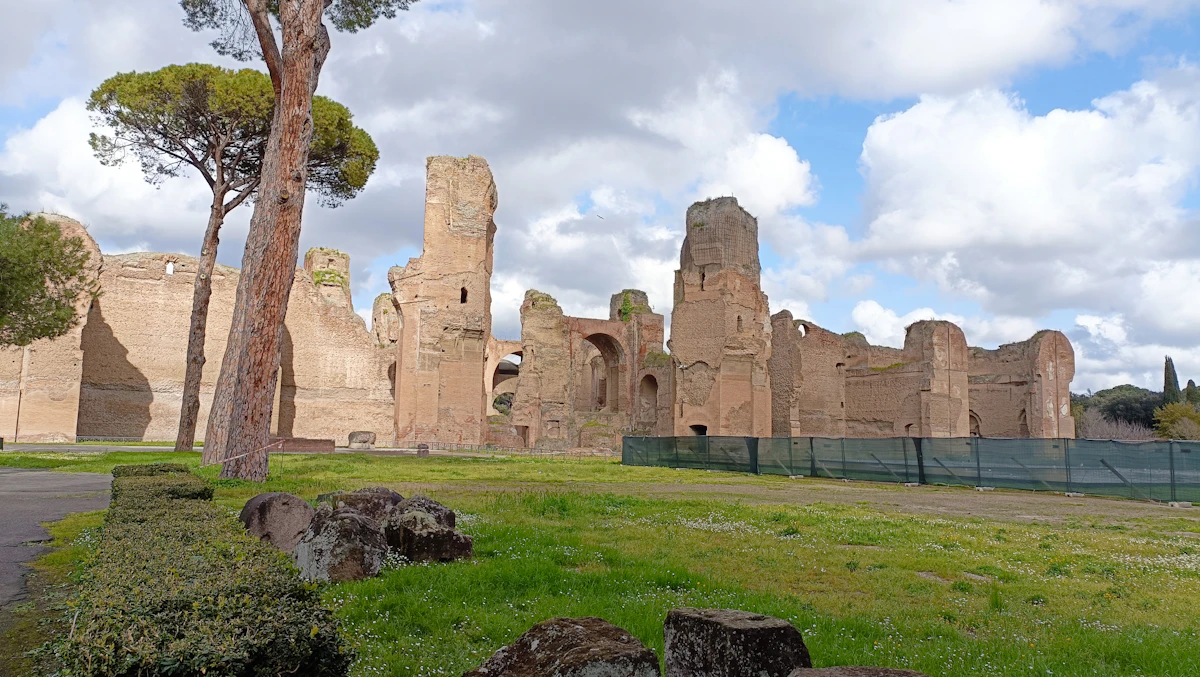
Baths of Caracalla Guide: Tickets, Prices & Visiting Tips
1 - 1.5 h
Ancient Roman Bath Complex
Built 212-216/217 AD under Emperor Caracalla
Viale delle Terme di Caracalla, 52, 00153 Roma, Italy
Planning to visit Baths of Caracalla?
Compare ticket and city-pass options for this attraction.
Practical Visitor Info & Tips
€8.00
€2.00
09:00 - 18:30, Tuesday-Sunday
Not mandatory; online booking available via the official Musei Italiani e-ticketing portal for a small advance-booking fee, or purchase on-site at ticket offices/kiosks.
| Year-round | Tuesday - Sunday | 09:00 - 18:30 | Last Admission: 18:00 |
Closed On: Mondays, 1 January, 25 December
Free Admission Dates: First Sunday of every month
Entry to the Baths of Caracalla archaeological site, one of the largest and best-preserved imperial Roman bath complexes, including its surviving mosaic floors and underground service tunnels.
| Option | Price | Reservation | Booking |
|---|---|---|---|
| Adult (year-round, Tue-Sun) | €8.00 | Not required | Musei Italiani |
| Reduced (EU 18-25) | €2.00 | Not required | Musei Italiani |
| Under 18 / First Sunday of month | Free | Not required | Musei Italiani |
Book tours & tickets
SponsoredProvided by our commercial partner GetYourGuide — bookings made through this section may earn LocalExperiences a commission. See our Editorial Transparency page.
Ticket Options
€8.00
Check whether a city pass already covers this attraction before buying separately.
See pass compatibility below ↓Overview & Visitor Introduction
The Baths of Caracalla were one of ancient Rome's largest public bathing complexes, built between 212 and 216/217 AD under Emperor Caracalla. The surviving brick-and-concrete shell — once covered in marble, mosaics, and statuary, much of it now dispersed to museums including the Naples Archaeological Museum — still conveys the scale of imperial Roman public architecture.
Standard admission is EUR 8.00 (EUR 2.00 reduced for EU citizens aged 18-25), with free entry under 18 and for everyone on the first Sunday of each month. The site is managed by the Soprintendenza Speciale di Roma and ticketed through the official Musei Italiani e-ticketing portal — a separate authority and booking system from the nearby Parco Archeologico del Colosseo.
The visit covers the vast central bathing halls (frigidarium, tepidarium, and the circular caldarium), surviving sections of original mosaic flooring, and the extensive underground service tunnels that once moved fuel, water, and staff beneath the bathing floors above.
In summer, the site is also a well-known opera and ballet venue, with Rome Opera performances staged among the ruins — a separate, additionally-ticketed evening event distinct from standard daytime admission.
History & Significance
Commissioned by Emperor Caracalla and largely completed by 216-217 AD, the complex could reportedly accommodate over a thousand bathers at a time, with public baths, gardens, libraries, and exercise courtyards (palaestrae) alongside the bathing halls themselves.
The baths functioned for roughly three centuries until the Ostrogothic sieges of the 6th century damaged the aqueducts supplying them, after which the complex fell into disuse and gradual ruin — much of its decorative marble and sculpture was removed over the following centuries, some of it ending up in later collections such as the Farnese family's holdings, now largely in Naples.
What to See: Top Highlights
The Caldarium
The vast circular hot-bathing hall, one of the site's most dramatic surviving spaces.
Surviving Mosaic Floors
Original floor mosaics still visible in several of the bathing halls and courtyards.
Underground Service Tunnels
The extensive substructure that once moved fuel, water, and staff beneath the baths.
Which is the Best City Pass for Rome?
We analyze prices, ticket options, and transport deals for Rome.
Location & Google Maps
Pass Compatibility
Compare Rome PassesIncluded as one of Roma Pass's and Omnia Card's free-choice admissions (via the bundled Roma Pass component) — confirmed directly on the pass's own official network page. Not named among Turbopass Rome City Pass's own itemized list of included attractions.
Roma Pass
Conditional. Free if this visit counts within your pass's included free-admissions quota. A discount applies once your pass's free-admission quota has been used; the exact current amount should be confirmed when booking. Explicitly named as a Roma Pass network archaeological site on the pass's own official page. One of the pass's free-choice admissions — the 72h Roma Pass grants 2, the 48h grants 1, visitor's choice, any order. Not automatically free beyond your quota.
Omnia Card 72h
Conditional. Free if this visit counts within your pass's included free-admissions quota. A discount applies once your pass's free-admission quota has been used; the exact current amount should be confirmed when booking. Included via Omnia's bundled Roma Pass component, same free-choice-quota mechanic.
Turbopass Rome City Pass
Not included. Not named among Turbopass Rome City Pass's own itemized list of included attractions/experiences — only an unrelated 'Ancient Rome Multimedia Video' (a digital 3D reconstruction product) is mentioned on the same page, which is a different product, not site admission.
Data Provenance
Book tours & tickets
SponsoredProvided by our commercial partner GetYourGuide — bookings made through this section may earn LocalExperiences a commission. See our Editorial Transparency page.
Frequently Asked Questions
How much does it cost to visit the Baths of Caracalla?
Do I need to book in advance?
Is the Baths of Caracalla included in Roma Pass?
Is it included in Turbopass or Omnia Card?
Is this the same ticketing system as the Colosseum?
How long should I plan for a visit?
Can I see an opera here?
Nearby & Related Attractions
Is a City Pass Worth It in Rome?
Compare pass options, prices, ticket entry rules, and transportation.
View Rome Pass Comparison