
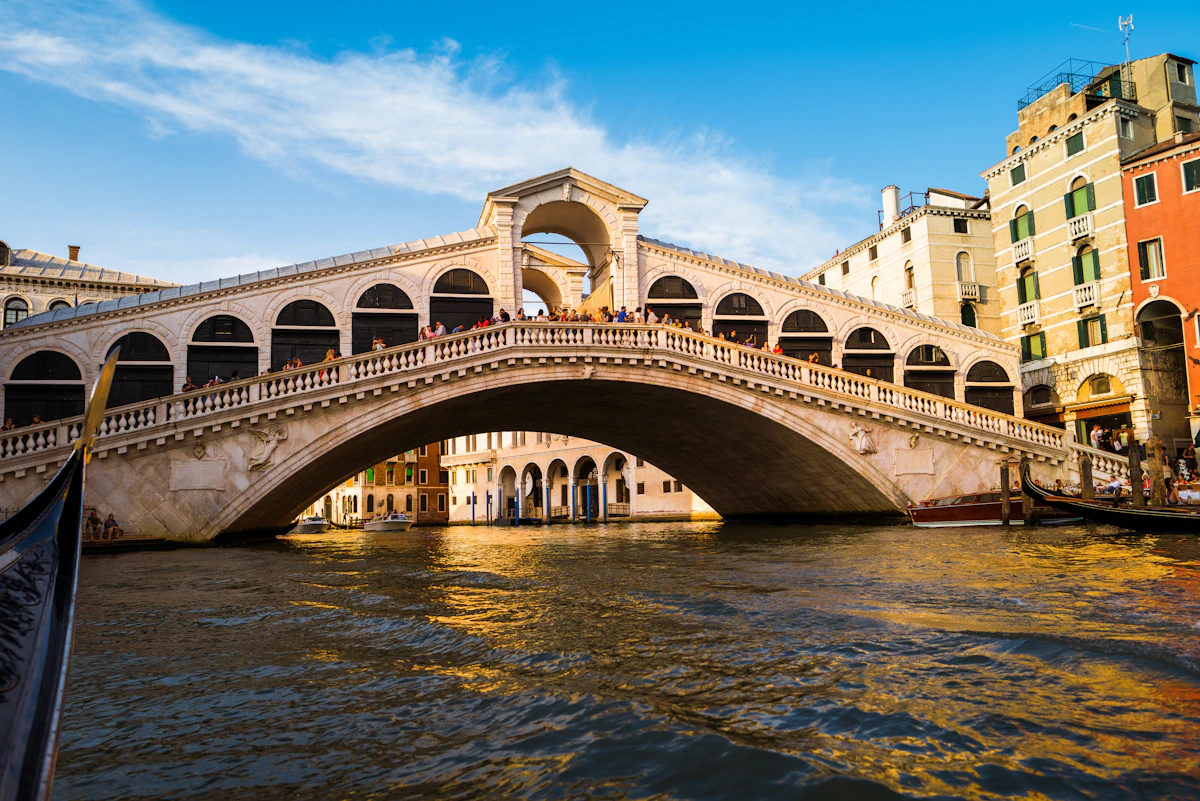
Rialto Bridge Guide: Free to Cross, Best Times & What's Nearby
15 - 30 min
Free Public Landmark
Present stone bridge completed 1591, designed by Antonio da Ponte
Ponte di Rialto, San Polo/San Marco, 30125 Venezia, Italy
Planning to visit Rialto Bridge (Ponte di Rialto)?
Compare ticket and city-pass options for this attraction.
Practical Visitor Info & Tips
€0.00
Free
Always open — a public pedestrian bridge with no gates or ticket office.
No reservation required for individual visitors.
Pedestrian crossing of the Grand Canal at its narrowest point, lined with small shops along its upper walkway. No admission product exists to buy.
| Product | Price | What It Covers | Booking |
|---|---|---|---|
| Crossing the bridge | Free | Open to the public at all times | Not required |
Book tours & tickets
SponsoredProvided by our commercial partner GetYourGuide — bookings made through this section may earn LocalExperiences a commission. See our Editorial Transparency page.
Ticket Options
€0.00
Overview & Visitor Introduction
The Rialto Bridge is the oldest of the four bridges spanning the Grand Canal and, along with St Mark's Square, one of the two or three most-photographed sights in Venice. Unlike every other attraction on this site, there is nothing to buy here: it is a public pedestrian bridge, free to cross at any hour, with no admission fee, reservation, or pass of any kind involved.
The single stone arch, completed in 1591 to a design by Antonio da Ponte, replaced a long succession of wooden bridges on the same site (the first dating to the 12th century) at what was then the only fixed crossing point of the Grand Canal. Its upper walkway is lined on both sides with small shops, a commercial use the bridge has carried since it was built.
Because it's free and always open, the only real planning question is timing: the bridge and the canal-side footpaths around it are extremely crowded in the middle of the day, especially in high season. Early morning (before roughly 8:30) or after sunset gives noticeably clearer photos and an easier walk across.
No pass or ticket of any kind applies here — the Venezia Unica City Pass, the MUVE Museum Pass, the Chorus Pass, and Turbopass are all about paid admissions elsewhere in the city, and have no bearing on a free public bridge.
History & Architectural Significance
A wooden bridge first crossed the Grand Canal at this location in the 12th century, rebuilt and widened several times (including a drawbridge version) before repeated collapses and fires prompted the Republic to commission a permanent stone replacement in the late 16th century. The design competition reportedly drew proposals from Michelangelo, Palladio, and Sansovino, among others, before the Senate chose the less famous Antonio da Ponte's design in 1588.
Da Ponte's single-span stone arch, completed in 1591, was considered a daring engineering achievement for its time, given the Grand Canal's width and soft lagoon-bed foundations at this point. The bridge has carried continuous rows of shops along its upper walkway since it was built, and remains structurally unchanged in its basic form more than four centuries later.
What to See: Top Highlights
The Single Stone Arch
Antonio da Ponte's 1591 design, considered a daring engineering feat for its era given the Grand Canal's width.
The Upper Walkway Shops
Small shops have lined both sides of the bridge's upper level continuously since the 16th century.
Grand Canal Views
One of the classic photo vantage points in Venice, in both directions along the Grand Canal.
The Rialto Market, Nearby
Venice's historic produce and fish market sits just a short walk from the bridge's San Polo side, active on weekday mornings.
Which is the Best City Pass for Venice?
We analyze prices, ticket options, and transport deals for Venice.
Location & Google Maps
Pass Compatibility
Compare Venice PassesThe Rialto Bridge is free and unticketed, so no pass — Venezia Unica City Pass, MUVE Museum Pass, Chorus Pass, or Turbopass — has any bearing on visiting it. There is no admission product to include or exclude.
Data Provenance
Book tours & tickets
SponsoredProvided by our commercial partner GetYourGuide — bookings made through this section may earn LocalExperiences a commission. See our Editorial Transparency page.
Frequently Asked Questions
Is there an entry fee for the Rialto Bridge?
Do I need a ticket or reservation to cross it?
Is the Rialto Bridge included on any Venice pass?
When is the best time to visit to avoid crowds?
How old is the current stone bridge?
Nearby & Related Attractions
Is a City Pass Worth It in Venice?
Compare pass options, prices, ticket entry rules, and transportation.
View Venice Pass Comparison